How the HIP Charter Was Made
The story behind the charter is itself evidence of what the charter describes.
The Problem
In March 2026, after a year of building with AI as a full partner across eight products and thousands of commits, the author faced a credibility gap. The narrative was landing as "guy who uses AI to code fast." It invited comparison with AI wrappers and missed the architectural depth of what was actually built. The products spanned four entirely different kinds of human-AI partnership, but there was no framework to describe that range.
The gap was felt viscerally: "The build 8 products and 3,000 commits line is not landing with me with pride."
The Partnership That Named It
What followed was a twelve-step naming process between a human (Nikhil Singhal) and an AI partner (Claude). The process itself became evidence of what the charter describes: human judgment driving every critical turn, AI capability accelerating the exploration, and governance working at every step.
Step 1. The human identified the gap. "We need to separate ourselves from the AI wrappers crowd."
Step 2. The AI mapped the landscape. Researched the wrapper debate across industry analysis, categorized the products by AI integration type, and proposed an initial four-level framework.
Step 3. The human pushed back. "Four may lock us down. What about 'stack'?" Introduced the constraint that the framework should not be rigid.
Step 4. The AI proposed candidates. "The Collaborative Intelligence Stack" emerged as a strong option.
Step 5. The human flagged a risk. "The Mira Lane link bothers me." Asked the AI to check USPTO and verify the name space.
Step 6. The AI researched. Found Mira Lane's MIT Press book Collaborative Intelligence (December 2024) and two USPTO filings with "Collaborative Intelligence" in the name. Confirmed the risk.
Step 7. The human steered the synthesis. Proposed weaving "Intelligence" from the "Just Intelligence" thesis into the name. Then: "The Human Intelligence Partnership Stack. Can be referenced as HIP Stack. Also indicates 'tied at the HIP.'"
Step 8. The AI validated. Confirmed clean namespace, no USPTO conflicts, connection to thesis.
Step 9. The human questioned the visual. "A stack can convey a funnel or hierarchy. What if we riff on a Venn diagram?" Recognized that "stack" fights the philosophy of equal partnership.
Step 10. The AI proposed alternatives. Venn diagrams, petal patterns, hybrid approaches. Suggested the petal/bloom metaphor: four overlapping petals around a center, extensible as new paradigms emerge.
Step 11. The human unlocked three things simultaneously. Saw that the petal model enables adoption planning for companies, intersections become progression markers for individuals, and new petals can be added for world models and embodied AI.
Step 12. The human found the final word. Opened a thesaurus, searched for alternatives to "framework," and landed on "Charter." A founding document that establishes the terms of a partnership between equals. Governance built into the name. Intent declared in the word itself.
Neither intelligence could have arrived here alone. The AI did not name it. The human did not research it. Together, in partnership, the name emerged from a process that neither intelligence would have followed independently.
8 Visual Iterations in One Day
The HIP Charter diagram went through eight major concept versions on March 16, 2026. Each was killed by a human insight. Each was rebuilt by the partnership.
| Version | Concept | What killed it |
|---|---|---|
| v1 | Four overlapping petal ellipses | "AI intelligence is not shown anywhere" |
| v2 | Added AI engine boxes below | "The three zones are not visually coming through" |
| v3 | Three sovereign zones | "The petals are NOT in the human zone. They ARE the intersection." |
| v4 | Cross-cutting Intent Layer | "The Intent Layer is not a separate layer. And we do not know if these petals will be relevant with new models." |
| v5 | Spanning boxes for pairs | Width implied importance. Foundation + Pipeline looked richer than Foundation + Tooling. |
| v6 | Diamond network graph | Center lines crossed. Labels crowded. |
| v7 | Combination lattice | 28 connection lines between rows created visual noise. |
| v8 | Split-color cards | Color encodes lineage. No lines needed. |
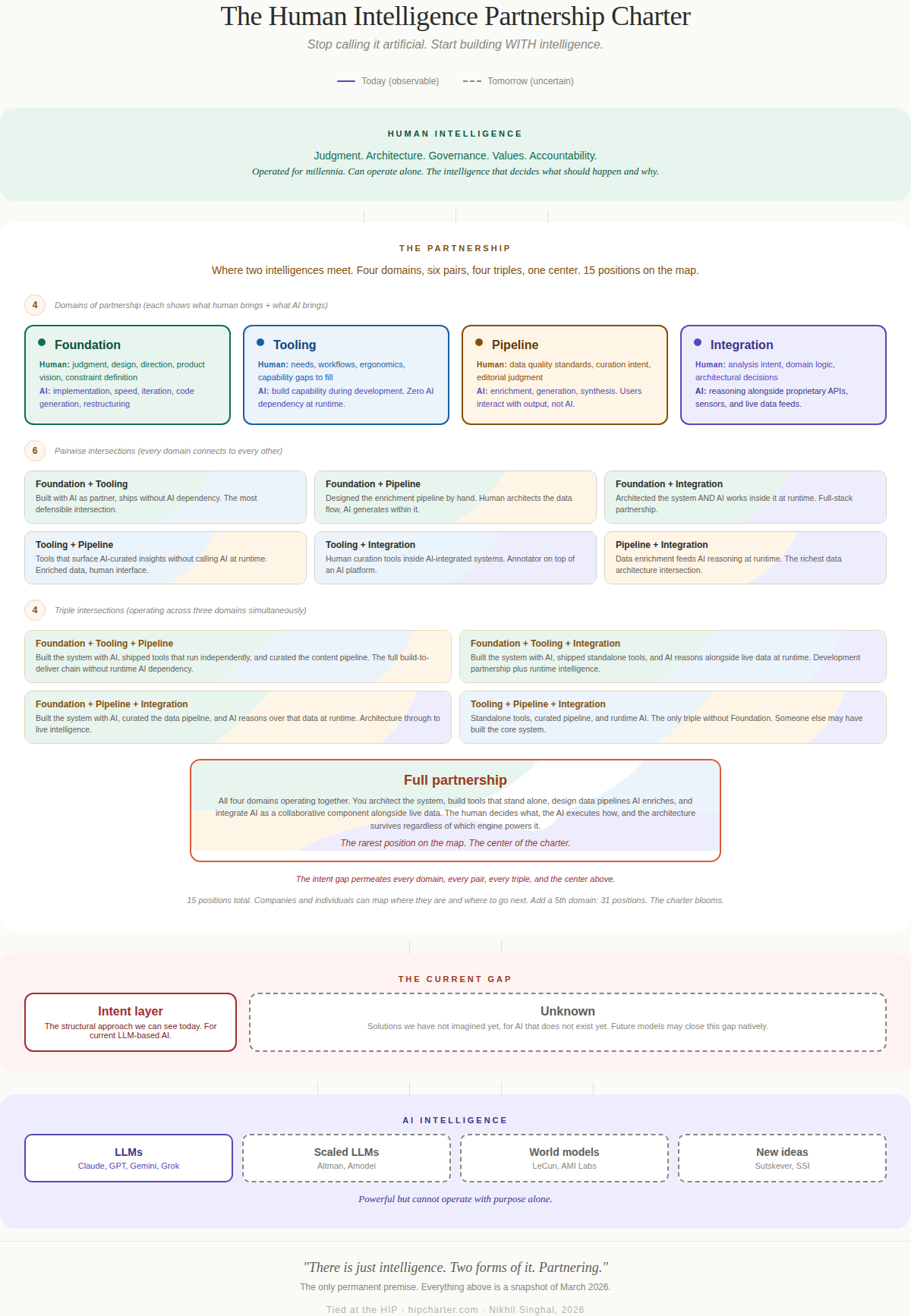
The v8 combination lattice. 15 positions on the map. Split-color backgrounds encode which patterns intersect at each position. The organic wave boundary between colors represents partnership, not hierarchy.
The breakthrough came from a whiteboard sketch. The human drew two colors meeting inside a card with an organic wave boundary. Not a diagonal. Not a gradient. An inclined S-curve that reads as "two territories partnering." The AI implemented it. The wave tilts from approximately 67% at top to 33% at bottom.
Color became the lineage. No lines, no dots, no arrows. The card itself tells you its parents.
Multi-Model Validation
During the visual iteration, the author threw the visualization problem at multiple AI models through Recurate (a platform he built at the Foundation petal).
Claude recommended a force-balanced network graph. GPT recommended a Venn diagram. Grok recommended an UpSet plot. Gemini timed out. Both Claude and Grok rejected a four-circle Venn for asymmetry.
The combination lattice synthesizes the best insights from all three: every position explicit (from the network graph), overlaps visible (from the Venn instinct), and all combinations enumerated (from the UpSet approach).
The Governance That Worked
The naming process, the visual evolution, and the multi-model validation all followed the same pattern the charter describes.
Human intelligence provided: strategic judgment, creative naming, risk identification, visual thinking, linguistic precision, the ability to recognize when a concept fights its own philosophy.
AI intelligence provided: research synthesis, alternative generation, trademark verification, visual implementation, structural organization, the ability to explore a space faster than any human could alone.
The governance worked at every step. When a naming candidate posed a brand risk (Mira Lane overlap), the human flagged it, the AI researched it, and the partnership course-corrected. When the visual metaphor (stack) fought the philosophy (equality), the human caught it, the AI proposed alternatives, and they converged on petals. When "stack" implied hierarchy, the human opened a thesaurus and found "charter."
Intent expressed. Risk identified. Concept evolved. Decision made. Documented.
That is governance as partnership, not governance as oversight. And that is exactly what the HIP Charter argues for.
Read the charter → About the author →
© 2026 Nikhil Singhal. Published by AI Trust Commons. Licensed under CC BY 4.0.